.png)

While the Federal Reserve “rate decisions” are consistently anticlimactic for sophisticated market watchers, with the decision consistently priced in near 100% by the eve of nearly every single “decision day” over the past few years, the meetings themselves can have a significant effect on rates, including DSCR Loan rates, as much or even more than the economic report releases and revisions. In addition, Federal Reserve members, including the all-important chair, will do speeches, talks and interviews from time to time – ranging from influential and closely watched – such as the Chair’s speech at the annual Jackson Hole Economic Symposium to routine television interviews with voting or even non-FOMC voting members. Each can have an effect on interest rates as they give further insights to the all-important Federal Reserve and how they are thinking about future rate decisions.
The key Federal Reserve events are the Federal Open Market Committee (FOMC) meeting dates themselves – eight per year. While the rate decision itself is usually fully baked in, the FOMC meetings come with a written statement (which usually contains minor changes, blacklined against the prior meeting’s statement) and the Federal Reserve chair does a press conference with financial reporters shortly after the rate decision and statement are released. In the some-would-say wacky financial climate we currently live in, Treasury yields can move dramatically up and down throughout the press conference itself, with some of the most major moves of the month occurring between words spoken out of the Fed chair’s mouth. This is because the market tends to hang on literally every word, feeding it into sentiment analysis models and algorithms and using it as the rare insight into the next Fed rate decision (typically a month or two away), for which now takes front and center for yields and rate moves. Sometimes, interest rates (Treasury yields, and mortgage rates as well) can reverse course significantly between the market digestion of the initial written statement and the happenings during the press conference and reporter Q&A an hour later.
For example, here’s a look at how violently yields can move up and down on a single day. The below chart shows yield movements on September 17, 2024 when the Federal Reserve made its first cut, 50 bps or a “double cut” at that, in four years. The chart illustrates how the market reaction was initially very positive with yields across the curve (from 2-Year Treasuries to 10-Year Treasuries) moving sharply down followed by a spike up and above where the day started as the press conference occurred:
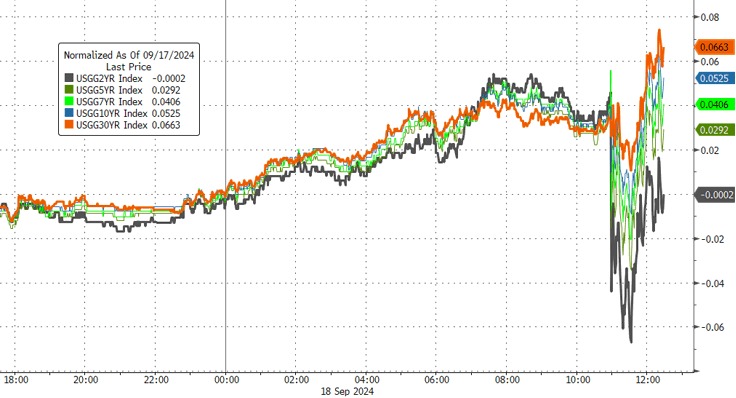
In sum, the Federal Reserve decision announcement, coming typically mid-morning, is baked in, but the market reaction to the press conference (both the Chair’s written statement and subsequent reporter Q&A is what typically) moves the markets and interest rates.
One of the most closely scrutinized pieces of Federal Reserve communication is the “Dot Plot,” published four times per year as part of the Summary of Economic Projections (SEP) following Federal Open Market Committee (FOMC) meetings in March, June, September, and December. Each dot on the chart represents a Fed policymaker’s projection for the appropriate level of the federal funds rate at the end of each of the next few years, as well as the longer run. The dots are anonymous, no one knows which policymaker belongs to which dot, but together they provide a snapshot of how the Fed as a whole sees the long-term path of interest rates evolving.
Markets watch the Dot Plot because it offers a window into the Fed’s thinking well beyond the current meeting. A shift in the median dot from prior dot plots can move rates significantly. A higher “median dot” can signal that the Fed expects inflation to remain sticky and that more rate hikes may be needed. Conversely, a lower median projection suggests that the Fed believes policy can ease sooner. Because Treasury yields, and by extension, mortgage and DSCR loan rates, are heavily influenced by expectations of future Fed policy, changes in the Dot Plot often move markets immediately after release.
The Dot Plot does not bind the Fed to any course of action, and it is not a promise. Economic conditions can change quickly, and policymakers often remind markets that the dots are forecasts, not commitments.
Still, bond investors treat it as one of the most important forward-looking guides to policy, and big surprises relative to market expectations can cause sharp moves in yields. For real estate investors, understanding the Dot Plot matters because it directly influences the interest rate outlook: a higher path of dots usually pushes mortgage rates up, while a dovish set of dots can bring them down and most importantly, for FOMC meetings and written statements where a new Dot Plot is published, it can be the driver behind yield and rate moves even more so than the actual decision or published statement, as future expectations are what matters most. Novice market watchers look only at the decision, experts look to the dots for crucial, forward-looking insights.

Q: What is the Fed Dot Plot and why does it matter for mortgage rates?
A: The Fed Dot Plot is a chart released quarterly that shows each Fed policymaker’s projection for future interest rates. Markets watch it closely because higher dots signal tighter policy ahead, pushing Treasury yields and mortgage rates up, while lower dots suggest easing that can bring rates down.
Beyond formal reports like CPI, PCE, or the Fed’s Dot Plot, markets also hang on every word spoken by Fed officials, a phenomenon often called “Fedspeak.” The term originated during Alan Greenspan’s tenure, when his intentionally opaque statements were notorious for forcing markets to read between the lines. Today, Fedspeak refers broadly to the constant stream of public remarks made by Fed policymakers in between meetings: scheduled speeches at economic conferences, academic panels, TV interviews on Bloomberg or CNBC, newspaper Q&As, and even town hall–style events hosted by regional Fed banks.
These comments matter because they offer hints about how the Fed views the economy and where it may take policy next. A regional Fed president might say inflation risks remain elevated and that “policy must stay restrictive,” nudging bond yields higher. Conversely, if the Fed Chair acknowledges slowing growth during a televised interview, markets may interpret that as an early signal of easing. While most of these speeches or interviews don’t move markets as dramatically as CPI, the Jobs Report, or the official FOMC press conference, they can influence yields and mortgage rates at the margin, especially when the words come from the Chair.
An important nuance to understand as well is the Fed’s blackout window. To avoid confusion or mixed signals in the days leading up to a policy decision, Fed rules prohibit officials from making public comments about monetary policy during this period. The blackout begins on the second Saturday before each FOMC meeting and lasts until the Friday after the meeting. During this stretch, Federal Reserve officials will not be on TV or the conference circuit talking rates, and markets shift their focus almost entirely to incoming economic data. Once the blackout ends, officials typically reemerge with a flood of speeches and interviews that reinforce or clarify the Committee’s decision, sometimes nudging yields and rates in the days after the meeting.
For real estate investors, the lesson is that rates are shaped not just by economic data and formal policy moves, but also by the tone, emphasis, and timing of Federal Reserve members’ public remarks. Traders dissect phrases like “higher for longer,” “data dependent,” or “closer to our goal” for clues. Even if the impact of Fedspeak is smaller than a major report or Fed decision, it still matters, particularly in the run-up to meetings and right after blackout windows end. In short: don’t ignore the chatter. Sometimes a single soundbite from the Fed Chair can move markets more than the official decision itself.
Q: What is the Fed Blackout Window?
A: The Fed blackout window is a period when Federal Reserve officials are barred from making public comments on monetary policy. It begins on the second Saturday before each FOMC meeting and lasts until the Friday after the meeting, ensuring markets focus on the official decision and statement.
Up Next: Treasury Auctions: How to Understand When Mortgage Rates Move When the US Sells Bonds
© 2026 Harpoon Capital, LLC. All Rights Reserved. WARNING: Unauthorized distribution, copying, or sharing of this guide is a violation of U.S. Federal Law and is punishable by civil penalties of up to $150,000 per violation. We aggressively enforce our intellectual property rights.