.png)

For decades, one of the most famous ways to make money in real estate has been flipping houses. Thanks to countless TV shows, YouTube channels, and books, the concept is universally recognized: buy a distressed property at a discount, fix it up, and sell it for more than you spent. The payoff comes from the difference between the all-in cost and the property’s improved market value, or After-Repair Value (ARV).
The BRRRR method uses the same value-add concept: buy below market, renovate, and create forced appreciation, but it diverges at the key decision point. Once the rehab is complete, the flipper sells the property, while the BRRRR investor keeps the property, rents it out, and then refinances it.
This distinction completely changes the outcome. A flip generates a one-time payday but the story ends there. A BRRRR deal generates recurring cash flow from rent, long-term wealth from appreciation and loan paydown and tax-free access to equity through a refinance. Over time, the gap widens even further: rents tend to rise, while a fixed-rate mortgage stays the same, increasing your monthly spread year after year.
A key difference is taxation. Flippers pay short-term capital gains taxes on their profits, often at the same rate as ordinary income, which can be quite high. BRRRR investors, on the other hand, take their money out via a cash-out refinance, which is debt, not income, meaning no immediate tax hit. The money pulled out can be recycled into the next deal without Uncle Sam taking a cut.

Q: What is ARV in real estate investing?
A: ARV stands for After-Repair Value. It represents what a property is worth on the open market after renovations are complete. In the BRRRR strategy, investors aim to create an ARV that is greater than the sum of their costs, purchase price plus renovation expenses. This “value-add” spread is what allows a refinance to pull cash back out and turn a single down payment into multiple deals.
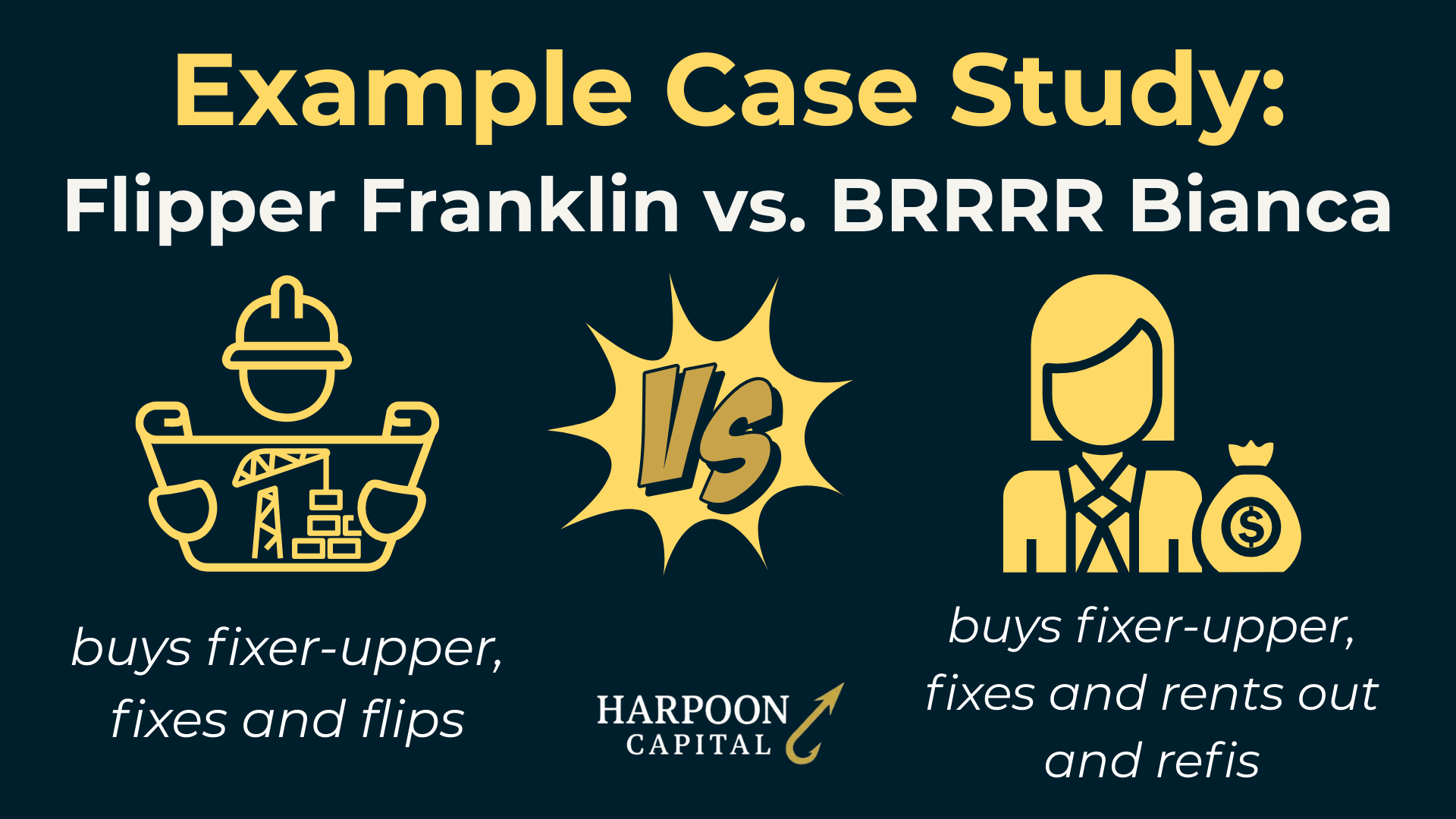
Let’s follow two real estate investors who find the same deal, but one, Flipper Franklin, eyes it for a traditional fix and flip, while the second, BRRRR Bianca, chooses to utilize the BRRRR strategy instead.
Both investors start with $15,000 in cash and use a hard money loan to finance the rest of the purchase and rehab. A hard money lender provides 90% of the total cost ($135,000), leaving Franklin and Bianca to bring $15,000 of their own money to the table. The hard money loan is roughly 67.5% of ARV, which is typical for investor-friendly hard money terms.

Q: What is the Loan-to-Cost (LTC) ratio in real estate investing?
A: The Loan-to-Cost ratio, or LTC, is a measure that hard money lenders use to determine how much of a property’s purchase and renovation cost they will finance. It is calculated before the deal closes, using the lender’s estimates of a reasonable acquisition price and rehab budget. For example, if a property will cost $200,000 to buy and $50,000 to renovate (total = $250,000), and the lender offers a $200,000 loan, the LTC is 80.0% ($200,000 ÷ $250,000 = 80.0%)
Now let’s see what happens for each investor after the renovation is complete.

Franklin’s plan is to sell as soon as the rehab is complete. On paper, the deal looks like a home run: the property is now worth $200,000 (equivalent to the estimates pre-renovation, this can happen, but real life is typically less exacting!), and his all-in cost was $150,000, leaving a $50,000 spread. But selling costs eat into that margin significantly. These typically include things like realtor commissions (the standard 5–6% fee paid to agents for listing and selling the home), pre-sale prep like cleaning or staging (minor costs to make the property market-ready), and closing costs at settlement (title, escrow, and transfer fees that usually run 1–3% of the sale price).
When Franklin sells the property for $200,000, the sale proceeds are used first to pay off the $135,000 hard money loan. He also recovers his original $15,000 cash contribution. After deducting the selling expenses of $17,500, he’s left with a net gain of about $32,500 before taxes.
Because Franklin held the property less than 12 months, his profit is classified as short-term capital gains, taxed at his ordinary income rate. If Franklin is in the 25% bracket, he owes about $8,500 in taxes, which reduces his final take-home profit to roughly $24,000 plus the $15,000 initial capital back in pocket.
So, while the numbers looked like a $50,000 spread on paper, what Franklin actually walks away with is about half that. He gets a quick payday and his cash back, but the property is gone, and with it any chance of long-term rental income, appreciation, or compounding wealth.

Bianca takes the exact same deal: a $120,000 purchase, $30,000 renovation budget, and an all-in cost of $150,000. The property appraises at $200,000 once the work is complete. Like Franklin, she finances most of the deal with a $135,000 hard money loan and puts in $15,000 of her own cash.
But instead of selling, Bianca follows the BRRRR path. She rents the property out, signing tenants to a lease as soon as renovations are complete and then an independent third-party appraiser confirms a new After-Repair Value (ARV) of $200,000.
The paths of Flipper Franklin and BRRRR Bianca diverge at this point. Instead of flipping, Bianca doesn’t put the property on the market, and pursues a refinance instead. Her lender allows a 75.0% LTV refinance, which results in a new loan of $150,000.
Just like Franklin, Bianca gets her $15,000 back, but key is that she also keeps the $200,000 property and from here, the advantages multiply. While she doesn’t realize any profit from the sale, assuming the property rents at $1,800 per month and has a $1,300 monthly PITIA payment, the property generates $500 per month in positive cash flow, or $6,000 per year. In addition, while the initial portion of the monthly payment that is principal is small, each month, the rental income pays down the mortgage loan balance, steadily building equity as the loan amortizes.
Additionally, while Flipper Franklin is totally removed from the property post-sale, Bianca realizes 100% of any property appreciation. If the property increases in value for example from $200,000 to $240,000 in a few years, Bianca captures all $40,000 in new equity. And just like the first refinance, she doesn’t have to sell to access it. She can do another cash-out refinance in the future, pulling equity back out tax-free because it comes in the form of a loan, not taxable. Even though the loan balance goes up, LTV stays the same, which means Bianca keeps a safe equity cushion while unlocking fresh capital to recycle into her next deal. And one final note, the $15,000 she pulled out in the refinance is debt, not income, meaning no capital gains tax is ever paid if she doesn’t sell the property.
This is what some investors call a “free rental property.” Bianca now owns a $200,000 income-producing asset with all of her money back in hand to use again. She has recycled her capital while gaining a property that will continue to pay her indefinitely.
And notice the asymmetry: Franklin’s flip produced about $24,000 in one-time after-tax profit. Bianca’s rental generates about $6,000 per year in cash flow. In just four years, she will have matched Franklin’s entire flip profit, but crucially, she still owns and will still own the property, with growing equity, appreciation and tax benefits.
In short, flipping and BRRRR both rely on the same value-add principle, but the outcomes couldn’t be more different. Franklin cashes out once and moves on, while Bianca keeps her money, her property, and the ongoing income stream. Over time, that difference compounds, each BRRRR deal not only produces tax-free capital to recycle, but also leaves behind a “free” rental property that continues to grow in value and cash flow for years to come.

Both BRRRR and flipping are built on the same foundation: buy at a discount, renovate, and create new value. The difference is what happens after the rehab is complete. Flippers sell the property and move on, while BRRRR investors refinance and hold. That single choice creates three major long-term advantages:
First, Cash Flow. Flipping ends with a one-time profit and once the property is sold, there’s no ongoing income. BRRRR investors keep the property as a rental, which means they earn monthly cash flow in addition to getting their original capital back through the refinance. And because most BRRRR refinance loans are fixed-rate and long term (i.e. 30-years, sometimes even referred to in investor circles as “permanent”), the mortgage payment stays the same while rents tend to rise over time, so the cash flow grows year after year.
Second, Equity & Appreciation. Flippers walk away from all future gains as soon as they sell. BRRRR investors keep the property and capture both natural appreciation and forced equity growth from loan paydown. Historically, home prices rise about 7% annually, so a $200,000 property could double in value over a decade. Meanwhile, tenants are paying down the loan principal balance each month through rent, which steadily builds additional equity. True wealth in real estate investing occurs on capturing this appreciation, something flippers simply don’t achieve when they opt for their quick fix.
Third, Taxes. Flipping profits are taxed as short-term capital gains, often at the same rates as ordinary income. That tax bite can take a large share of the profit. BRRRR investors avoid this problem by using a cash-out refinance instead of selling. Because a refinance is a loan, not income, the money they pull out is tax-free, leaving more capital to reinvest in the next deal without giving a cut to the IRS.

Q: Do you pay taxes on a cash-out refinance?
A: No. Cash-out refinance proceeds are not taxable because they are considered a loan, not income. When you refinance a property and pull out equity, you are borrowing against the value of your property. Unlike selling, where profits are taxed as capital gains, a cash-out refinance gives you access to your equity tax-free while you continue to own the property.
Up Next: We'll Take a Look at The BRRRR Strategy vs. Traditional Buy-And-Hold
© 2026 Harpoon Capital LLC. All Rights Reserved. WARNING: Unauthorized distribution, copying, or sharing of this guide is a violation of U.S. Federal Law and is punishable by civil penalties of up to $150,000 per violation. We aggressively enforce our intellectual property rights.