.png)

.png)
In addition to the importance of understanding the structure of your loan, a firm grasp on the two key financial metrics used by DSCR Lenders to qualify, price and underwrite your deal is also critical for being a well-informed borrower. These two key financial metrics are LTV (Loan-To-Value Ratio) and DSCR (Debt-Service-Coverage-Ratio).
When DSCR Lenders make loans to real estate investors, the primary purpose is to earn a return (or reward), mainly through fees and interest payments, that meet or exceed the risk that the money is lost. In the case of DSCR Loans, the primary risk for the lender is not the risk that the borrower defaults (fails to pay back the loan). Since DSCR Loans are secured loans with real estate as collateral, the primary risk for DSCR Lenders is the risk that in case of a default, their capital (i.e. money that is lent out and owed) is not paid back through the foreclosure remedy.
For example, if a DSCR Lender makes a $750,000 loan that is secured by a property worth $1,000,000 and the borrower defaults, the lender doesn’t lose money if they are able to take over the ownership of the subject property through foreclosure and then sell that property for an amount greater than the amount they are owed (remaining loan balance + fees/interest accruals and any holding/selling costs). So, in this example, if the lender is due a balance of $740,000, accrued interest and fees of $20,000 and foreclosure and selling costs of $40,000 for a total of $800,000 ($740,000 + $20,000 + $40,000), and is able to sell the property for $800,000 or more (remember, this property was worth $1,000,000 when the loan was originated), then the lender not only receives all the money that is due, but sometimes might even make money on this process! (In this example, that would be if the property was sold for more than $800,000, or the amount owed/due).
Overall, the primary purpose of these important DSCR Loan financial metrics is to evaluate the risk that the borrower defaults and, in those cases, the risk the lender won’t be able to be made whole through foreclosure or other recourse.
.png)
The LTV (standing for “loan-to-value”) ratio is arguably the most important property-level financial metric for DSCR Loans. Yes, even more important than the DSCR ratio (even though they are called “DSCR Loans” not “LTV Loans”)! LTV is a simple, yet very important metric. It is the amount of the initial Loan Amount divided by Property Value. LTV is often referred to as “leverage” by finance professionals and real estate investors alike.
The LTV ratio is so important because as described above, the lender’s main recourse to redress a case of default, the primary risk for a lender in DSCR Loans, is to foreclose on the property and be “made whole” through selling the real estate collateral. As such, a lower LTV translates to reduced risk of loss for the lender, providing a bigger “cushion” or "buffer" should foreclosure become necessary.
Take an 80.0% LTV ratio case as an illustration (for instance, when a borrower buys a property with a 20% down payment): on a $1,000,000 property, this results in an $800,000 loan alongside $200,000 in borrower equity serving as that buffer. Under these circumstances, if default occurs and foreclosure follows, the lender remains shielded from losses provided the property's value hasn't fallen by over 20% ($200,000), ensuring the asset's worth (and post-foreclosure sale price) exceeds the unpaid debt and other costs, such as accrued interest and fees as well as the costs of foreclosing and selling the property, which typically include legal costs, repairs and upkeep and agent selling commissions. Note that at a high level, the “cushion” that LTV measures is the difference between property value and loan balance, however, it’s always important to remember all these other associated costs that are incurred if foreclosure must happen, which can significantly eat into said cushion.
So how does this affect borrowing terms? Simply, the lower the LTV, the better the terms for the borrower, as it increases the “cushion” for the lender or note holder in the case of declining value and a required foreclosure. In the above example, the value of the property would have had to decrease by over 20% for the lender to lose money (not taking into account accruals or other costs), an unlikely but plausible scenario. However, if the LTV had been 60.0%, i.e., a $600,000 loan on a $1,000,000 property, the value would have had to decrease by an enormous 40% or $400,000 for the lender to be in a loss position. Much less likely! Thus, the lender can offer better terms (like a lower rate) on the 60.0% LTV DSCR Loan as this lower leverage level indicates a much smaller risk of not being able to be “made whole” in case of foreclosure, since the so-called “cushion” is much higher.
Q: What is the maximum LTV or loan amount available with a DSCR Loan?
A: Generally, the maximum DSCR Loan LTV is 80% with a small number of lenders offering 85% LTV DSCR Loans, but only in rare cases. DSCR Loans secured by a single property typically have a maximum loan amount of $3.5 Million, but some more conservative lenders will have lower maximums, such as $2 Million or $2.5 Million.
.png)
DSCR stands for Debt Service Coverage Ratio, which is a simple financial metric: it’s generally defined as the ratio of a property’s revenue to its debt obligations. In a DSCR Loan, lenders look at the property’s rental income relative to the mortgage payment (debt service plus any escrows) to determine the loan’s qualification and terms.
It is important to differentiate the DSCR Ratio, which is a financial metric utilized for DSCR Loans but also utilized by lenders offering other types of loans, such as commercial real estate loans and even business loans. When considering DSCR Loans, it is vitally important to use and understand the version of the DSCR Ratio that DSCR lenders use and to not confuse the name of the loan product “DSCR Loans” with the mathematical formula.
The formula used to compute DSCR Ratio varies among different loan types and is calculated differently by business lenders, commercial real estate lenders and DSCR Lenders. Of particular importance: the DSCR formula utilized by DSCR lenders is different from the DSCR formula utilized by CRE lenders. This has been a large source of confusion among borrowers and real estate industry professionals alike.
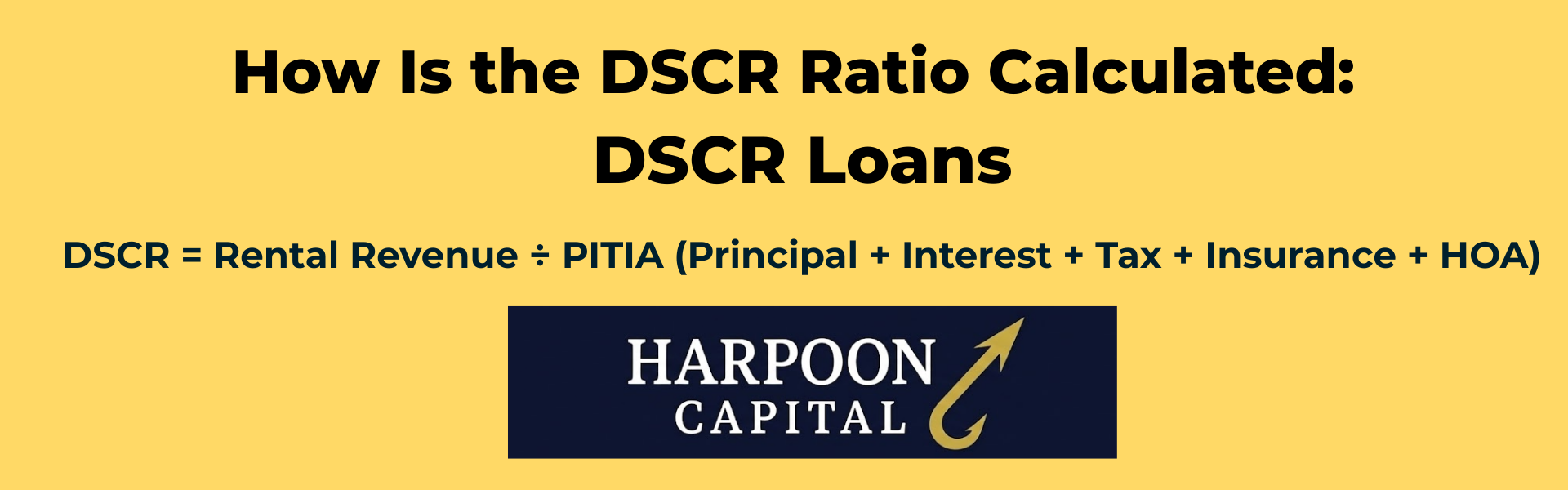
DSCR Lenders calculate DSCR Ratio with the following formula:
DSCR = Rental Revenue ÷ PITIA (Principal + Interest + Tax + Insurance + HOA)
The numerator in the DSCR formula is the rental revenue of the property, meaning the expected rents the property will generate on a monthly basis. This revenue is generally based on what the lender expects the property to earn per month for the upcoming year after the loan is closed and can be based on a long-term lease agreement, expected short-term rental payments (i.e. from Airbnb, VRBO, etc.) or even projected market rents on a vacant property. While some sources will use the term “income” for the numerator, “revenue” is a better fit here as personal income or earnings from other sources besides rent are not included in this number.
The denominator in the DSCR formula is what is generally referred to as the “PITIA” payment, which stands for the sum of monthly principal, interest, taxes, insurance and Association (HOA) dues. Principal represents the amount of the loan balance paid back each month while Interest represents the interest payment due. Most DSCR Loans are fully amortizing, meaning the monthly payment of principal and interest is fixed for the entire term although the portion that is principal and the portion that is interest can vary. The “Taxes” in PITIA represent monthly property taxes (only the taxes associated with the specific property used as collateral) that are often collected by the lender to make sure property taxes are paid in full whenever due. The “Insurance” in PITIA represents monthly property insurance (plus flood insurance if property is in a flood zone) that is also often collected by the lender to ensure the property is fully insured. Finally, “Association Dues” (a little confusingly representing the “A” in PITIA, but commonly referred to as “HOA dues”) represents any HOA dues owed monthly. This is not applicable for most DSCR Loans and DSCR ratios but comes into play typically when the property is in a condominium project or PUD (planned unit development). Additionally, in rare cases in which the property is owned in a leasehold interest and ground rent is owed, ground rent is included. Also, if there are any special assessments from the county that are not fully paid off at closing and expected to continue into the following year, these amounts would typically be included by the DSCR Lender into the formula as well.
.png)
Q: How Do I Calculate the DSCR Ratio for My Property
A: When qualifying for a DSCR Loan, the DSCR Ratio is calculated by dividing the expected PITIA payment (mortgage payment plus property taxes and insurance, as well as any HOA dues if applicable) by the property’s expected rental income. It is important to note that DSCR Loans do not include any other expenses in this formula, and DSCR Ratio for DSCR Loans is calculated differently than for commercial real estate loans, which typically use the formula NOI divided by debt service payment (principal + interest).
When expected rental income and monthly PITIA are equal, the DSCR is 1.00x, indicating a “break-even” scenario. That means the property generates just enough revenue to cover its PITIA payments, no more, no less.
Most investors aim for a DSCR above 1.00x, which means the property brings in more rents than its monthly payment and in real estate parlance, it “cash flows.”
For example, if Rental Income is $2,000/month and the PITIA is $1,600/month, then a DSCR Lender would calculate the DSCR as 1.25x ($2,000 ÷ $1,600 = 1.25). A DSCR of 1.25x means the property earns 25% more than is needed to cover the loan, or put another way, the rental income covers the debt with a 25% margin.
On the flip side, a DSCR below 1.00x signals negative cash flow. For example, Rental Income is $1,600/month and the PITIA is $2,000/month, then a DSCR Lender would calculate the DSCR as 0.80x ($1,600 ÷ $2,000 = 0.80). A DSCR of 0.80x means the property is covering only 80% of the PITIA payment with rental income. That shortfall must be made up from reserves or outside income, a scenario most lenders and real estate investors try to avoid, except in rare, extenuating circumstances.
One of the big advantages of DSCR loans is how the DSCR ratio is calculated, generally considered to be very “borrower-friendly,” especially when compared to the formula used by commercial real estate lenders.
.png)
In CRE lending, the DSCR formula is:
DSCR = Net Operating Income (NOI) ÷ Debt Service (Principal + Interest)
Net Operating Income, in this formula, takes expected rental income from the property and subtracts all the relevant expenses, including property taxes, insurance and any association dues, but typically many more expenses as well. Typically, a DSCR Ratio calculated by commercial real estate lenders will include expenses such as repairs and maintenance, property management fees, landscaping, utilities and more; which are not included in the formula for DSCR Loans. Additionally, CRE Lenders will also typically include estimated expenses referred to as “Vacancy and Credit Loss” to approximate estimated losses incurred from lapses in tenancy (vacant units where no rents come in) and credit losses (an allowance for instances where tenants fail to actually pay rents).
Both the difference in formula and the difference in DSCR minimums illustrate a “double whammy” of why DSCR Loans are so much more “borrower-friendly” when it comes to qualification than traditional commercial real estate or bank lenders for rental properties. Not only does the formula for DSCR ratio for DSCR Loans exclude many property expenses that can lower cash flow on paper, but the minimums themselves are also typically way lower too – typically 1.00x or 0.75x (or sometimes, no minimum DSCR ratio at all!)
While these borrower-friendly DSCR ratio rules make DSCR Loans a favorite of real estate investors across the industry, it is important for savvy investors to remember that the real world doesn’t work on paper and to always underwrite and accurately evaluate deals yourself, even if your DSCR Lender is giving you friendly numbers – it’s always smart to be conservative and plan for all the costs and risks that could come. Additionally, many online sources mix up these formulas, so when you’re evaluating deals, make sure you’re comparing the right type of DSCR for your specific loan product, and fully confirming with the lender their methodology and formulas used.
A solid understanding of LTV and DSCR ratios are key to being a well-informed borrower when considering DSCR Loans for your real estate investment portfolio. These two metrics are two of the three (along with qualifying credit score) most important numbers when it comes to qualifying for a DSCR Loan and determining how favorable the interest rate and other terms are. We will cover additional facets and nuances of how these ratios are computed and used by lenders in later sections of this guide as well as helpful tips and advice to optimize your loan terms by structuring your deals with strong LTV and DSCR metrics.
.png)
Q: How is the DSCR calculated on a DSCR Loan with interest-only payments?
A: The DSCR is still calculated the same way: Monthly Rent ÷ PITIA. But for interest-only loans (Partial-IO), the "P" and “I” (Interest) portion is lower during the IO period (since the principal is $0) — making it easier to hit DSCR thresholds. Lenders will calculate the DSCR based on the actual IO payment, not the future amortizing one, resulting in more favorable qualification terms.
Up next, Part 7 of our guide goes over the key question: Why Use a DSCR Loan? and why many real estate investors choose to use leverage to fund their portfolios.
© 2026 Harpoon Capital LLC. All Rights Reserved. WARNING: Unauthorized distribution, copying, or sharing of this guide is a violation of U.S. Federal Law and is punishable by civil penalties of up to $150,000 per violation. We aggressively enforce our intellectual property rights.