.png)

If you are like many real estate investors, your first experience with mortgage loans likely was with “conventional loans.” Conventional Loans are the industry name for loans that follow the qualification standards of the quasi-government agencies Fannie Mae and Freddie Mac (also sometimes called “QM” or “Qualified Mortgages”). These loans are intended to be sold to these agencies and securitized with an implicit government “guarantee” for mortgage bond investors, and must follow the strict one-size-fits-all qualifying standards of Fannie and Freddie.
Many people use these conventional loans for their “homesteads”, or owner-occupied properties. However, conventional loans can also be used for second homes or vacation properties and even investment properties like rentals. Because of the government’s implicit guarantee of these loans, conventional loans are often the first choice for homeowners and real estate investors alike, since the guarantee is a form of government subsidy and these loans typically come with lower rates.
However, as we will explore in this section, for many reasons and in many situations, DSCR Loans can be better options for real estate investors than conventional loan alternatives. This is true despite the fact that DSCR Loans are offered by private lenders and when sold and securitized, do not have subsidy or backing from the Federal Government. In fact, DSCR Loans quite often make the most sense for investors, especially as they begin to scale rental portfolios.
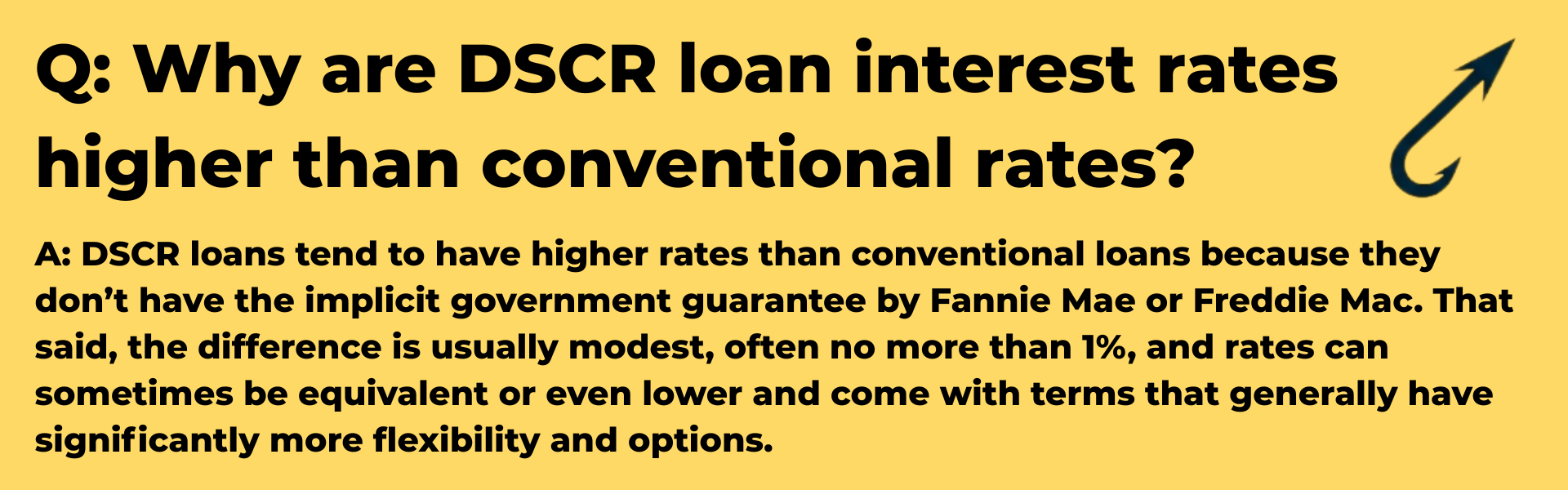
Q: Why are DSCR loan interest rates higher than conventional rates?
A: DSCR loans tend to have higher rates than conventional loans because they don’t have the implicit government guarantee by Fannie Mae or Freddie Mac. That said, the difference is usually modest, often no more than 1%, and rates can sometimes be equivalent or even lower and come with terms that generally have significantly more flexibility and options.
How DSCR Loans compare to conventional mortgages is a deeper question than just comparing interest rates. Yes, rates tend to be higher, but there are many “pros” to DSCR Loans that can be used by savvy real estate investors to scale rental portfolios.
Every financing strategy has its upsides and trade-offs. Let’s break down the advantages and disadvantages, and dispel a few DSCR Loan myths while we’re at it.
For real estate investors scaling portfolios or operating outside traditional borrower profiles, DSCR Loans offer a unique set of advantages. Unlike conventional mortgages constrained by government guidelines, DSCR loans are designed specifically to align with how investors think: property-first, cash-flow driven and built for scale. Below are five core benefits that make DSCR Loans a powerful financing tool for sophisticated investors:
One of the most powerful advantages of DSCR loans is that they do not require borrowers to verify personal income or calculate a debt-to-income (DTI) ratio. Investors aren’t required to submit W-2s, tax returns, pay stubs, or profit-and-loss statements. Instead, the focus on a debt-service-coverage (DSCR) ratio, which evaluates how cash flow generated by the subject property covers the monthly PITIA payment (principal, interest, taxes, insurance and HOA fees, if applicable).
This is a major benefit for self-employed borrowers, real estate professionals with significant write-offs or investors who have already accumulated several properties and have complicated “on-paper” financial profiles, potentially with complex tax strategies and business interests that can complicate conventional financing. With DSCR loans, borrowers won’t be disqualified because of the way personal income looks on paper or because of a breach of an arbitrary portfolio or DTI ceiling.
This structure reflects how real estate investing actually works: strong deals pay for themselves. Investors can qualify based primarily on property performance, not their job title or income type. Why should someone need to stay in a W-2 job for years just to qualify for a rental property that cash flows by itself? DSCR loans unlock the wealth-building power of real estate for qualified borrowers who may not fit inside the traditional lending box or are ready to make the leap into full-time real estate investing.
.png)
Q: Do DSCR loans require income verification or tax returns?
A: No. One of the most popular aspects of DSCR Loans is that there is no requirement to provide pay stubs, employment information or tax returns, allowing both easier qualification and less hassle! There is no DTI (Debt-To-Income) ratio required in qualifying; instead rental income from the property is utilized and lenders don’t look at personal income or employment.
DSCR loans are built for professional investors and that includes supporting entity-based property ownership. Most DSCR Lenders not only allow but often encourage borrowers to take title in an entity like an LLC, corporation, partnership or trust. This approach provides significant advantages for real estate investors such as asset protection, tax structuring and operational flexibility. Holding properties in an entity helps separate liability from personal finances and credit, and simplifies building partnership structures.
This is especially useful for investors whose strategies include collaboration with others who have complementary skill sets: one person may bring capital, another may manage operations, and another may focus on acquisitions or design. DSCR Loans make it easier to structure these partnerships cleanly under one entity, with clear ownership roles and protections in place. This flexibility also allows for more sophisticated arrangements, such as small syndications or using multiple LLCs to manage different parts of a portfolio.
While DSCR Lenders typically require a personal guarantee from the borrower(s), many will allow minority owners, typically those owning less than 25% of the borrowing entity, to not have to provide a guaranty. In addition, some lenders will qualify the loan using the higher of two borrower credit scores in a partnership, giving more flexibility when structuring who signs and how credit is evaluated.
Finally, DSCR Loans held in LLCs often do not appear on the borrower’s personal credit report, reducing credit utilization concerns and further insulating the investor’s personal financial profile. For serious investors treating their real estate business like a true enterprise, DSCR Loans can level the lending playing field, with access to entity-friendly benefits usually reserved for only institutional-level players.
.png)
Q: Can I get a DSCR loan under an LLC or business name?
A: Yes! In fact, most DSCR Lenders prefer that you borrow under an LLC or entity and in some states this arrangement is required. Additionally, DSCR Loans are typically available to be in the name of trusts or corporate fund structures.
DSCR Loans routinely allow for higher loan amounts than traditional agency or bank loans. While conventional loan limits cap out at $832,750 for a single-family property in 2026 (with some exceptions in high-cost markets and for 2–4 unit properties), DSCR Loans often extend well into the seven figures. Many lenders offer DSCR Loan sizes up to $3 million per property, and specialized programs can go even higher for select investors or portfolio loans.
This opens the door to more advanced investment strategies, which can be critical in today’s challenging rate environment. Investors who focus on high-performing short-term rentals (STRs) in luxury markets or high-demand destinations like Orange County, California, or Manhattan, where average single-family home prices regularly exceed $1.5 million, often find that conventional loan limits fall short. DSCR Loans provide a financing option for real estate investors focusing on high-end rentals, which can be some of the most lucrative properties available – and a necessity in some markets where saturation has made it a requirement – not a luxury – to stand out in size and quality.
Conventional financing places a hard cap on portfolio growth as agency guidelines strictly limit borrowers to a maximum of 10 financed properties per individual, including primary and second homes. Once that threshold is reached, conventional loans are no longer available, regardless of credit score, reserves, or property performance. For serious investors looking to scale, this ceiling becomes a major roadblock to finding true financial freedom through real estate.
DSCR Loans have no such restriction or hard cap on number of properties. Because each loan is evaluated primarily on the income of the property itself, lenders are typically unconcerned with how many other properties the borrower owns, and neither income and expenses from personal professions nor profits and losses from other properties are typically considered in DSCR Loan qualification. This flexibility is essential for investors pursuing financial independence, whether through long-term rentals, STRs or a diversified portfolio strategy. For many, building a portfolio of 10 or more properties is the point at which real estate becomes a full-time income source and DSCR Loans are often the only practical path to get there.
.png)
Q: Is there a limit to how many DSCR loans I can have?
A: No. DSCR Loans generally contain no cap on the number of properties or loans you can have, making them ideal for investors building portfolios with 10 or more rental properties. Some DSCR Lenders may have caps for individual borrowers, but they are usually never hit (i.e. at 25 properties or >$10 million in real estate) and crucially, apply to each lender individually, so borrowers can typically reset any caps with a new DSCR lender.
One of the strongest advantages of DSCR loans is their flexible and adaptive underwriting. Because these loans are not bound by Fannie Mae, Freddie Mac, or FHA rules, DSCR Lenders create their own qualification standards and guidelines, allowing them to move faster, evaluate a broader range of property types, and accommodate evolving strategies like mid-term rentals or BRRRR more effectively than conventional lenders.
With the ability to move quickly and adapt much more smoothly to emerging strategies and real-life borrower needs, DSCR Loans have become the top (and sometimes only) option for several areas of real estate investing. Some of these areas include the BRRRR strategy, where investors need to be able to execute cash-out refinances in short-time frames, much more quickly than conventional options allow. DSCR Loans also routinely offer better terms for non-traditional rental property types such as short term rentals, so-called non-warrantable condos and even multi-unit properties past the arbitrary four-unit conventional minimum. Finally, DSCR Lenders have much more leeway in being able to evaluate deals on “case-by-case” basis and grant exceptions. This is not an option for conventional lenders who must comply with strict rules and regulations.
This flexibility empowers investors to pursue creative deal structures, act quickly on time-sensitive opportunities, and finance properties that don’t fit neatly into conventional underwriting checklists.
Just as important: DSCR Loans typically require far less burdensome documentation requirements. While not “no-doc,” they eliminate many of the most frustrating elements of traditional mortgage applications such as explaining every bank deposit, submitting full tax returns or justifying personal income from multiple sources. For investors managing multiple deals and entities, this can save time, reduce stress and allow for a more scalable acquisition process. In short: DSCR Loans are built to support how investors actually operate in the real world. Investors using DSCR loans are not forced into the slow-moving system of conventional financing built for average families and homeowners.
.png)
Q: Who is a typical DSCR loan borrower?
A: DSCR Loan borrowers can include everyone from first-time investors to moguls with over a hundred properties. However, the “sweet spot” for DSCR Loan borrowers are those with five to 50 properties; ready to scale after their first few, but not quite institutional in nature.
Collectively, these benefits explain why DSCR Loans have exploded in popularity and have become the go-to loan option for real estate investors scaling portfolios. Many real estate investors “make the leap” from conventional loans or local banks when they hit around five properties. Whether it’s hitting up against DTI limits, scaling past loan limits, entering the high-end markets or simply becoming tired of hassles, the road to financial freedom through rental properties often arrives at DSCR Loans once the properties start adding up.
It’s not all sunshine and roses. The flexibility of DSCR Loans comes at a cost, usually in the literal sense of higher interest rates and fees, and they aren’t the right tool for every scenario. Here are some key disadvantages to weigh when considering if a DSCR Loan is the right choice for financing a rental property.
DSCR loans typically come with interest rates that are 0.75% to 1.00% higher than comparable conventional mortgages. This reflects the added risk that comes with both the lack of an implicit government guarantee and the qualification process that doesn’t verify personal income or use debt-to-income ratios. However, the impact may be less than many expect: on an average-sized loan, for example with a balance of $400,000, the monthly payment at 7% (DSCR) vs. 6% (conventional) is only about $263 higher per month on a 30-year fixed mortgage, a manageable difference for many investors, especially when the deal cash flows, and when the lower paperwork and hassle allows you to move quickly enough to get the deal in the first place!
In addition to higher rates, closing costs are often slightly steeper on DSCR Loans. It’s common for DSCR Lenders to charge 1–2% in origination points, and additional fees may apply for legal review of LLC documentation or more complex appraisals, particularly for multi-unit properties or rural vacation rentals. While the costs are real, many investors view them as a reasonable tradeoff for the ability to finance deals that wouldn’t qualify under traditional lending guidelines.
DSCR Loans are strictly for non-owner-occupied properties. That means no owner-occupancy at all, not even partial, like in house hacking or utilizing a vacation home as part-time personal, part-time rental property. For investors looking to “house hack,” such as planning to buy a duplex, live in one unit, and rent the other - a common and effective starter strategy for real estate investing- DSCR Loans cannot be used. These loans require borrowers to certify through legal documents that the property will be used solely for business purposes, and lenders take occupancy fraud seriously.
Similarly, DSCR loans aren’t eligible for second home use. Many real estate investors like to mix the real estate business with pleasure, enjoying a vacation property both for personal use and to provide rental income. However, for vacation properties financed with DSCR Loans, personal use must be limited to no more than 14 days per year. Anything more, and the property would no longer qualify under DSCR Loan business-purpose requirements. These restrictions make DSCR Loans a poor fit for hybrid-use strategies as they are designed for pure investment properties with specific income-producing intent.
Another commonly cited “downside” to DSCR loans is the prepayment penalty — a provision in some DSCR loans that requires the borrower to pay a fee if the loan is paid off early (whether through a sale or refinance) during the first few years of the term. Prepayment penalties come in various forms, with different fee amounts and durations (i.e. how many years into the loan term they apply). While DSCR loans don’t typically require a prepayment penalty, borrowers will generally need to accept one, often covering the first five years of the term and sometimes amounting to up to 5% of the loan balance, in order to access interest rates comparable to conventional loans.
While these penalties are clearly a negative (compared to paying no penalty when selling or refinancing), they’re not purely a downside. In general, the higher and longer the prepayment penalty, the lower the interest rate. Borrowers willing to accept the most aggressive prepay structure (typically 5% for the first five years) may be able to secure a rate even lower than conventional alternatives. Many real estate investors follow a long-term buy-and-hold strategy and have no intention of selling within five years — making the lower rate a net benefit. DSCR Lenders also often offer flexibility with different prepayment structures, giving savvy borrowers the ability to align financing with strategy, a level of customization and optionality rarely seen in conventional lending.
.png)
Q: Do DSCR loans have prepayment penalties?
A: Yes, most DSCR loans include a prepayment penalty if you pay off the loan early, typically within the first 3 to 5 years. The penalty can be as high as 5% of the loan balance, depending on the structure. Some lenders offer options to reduce or remove the penalty in exchange for a higher rate or additional fees. Always review the prepay terms before closing and note that prepayment penalties are not allowed or have restrictions in some states.
DSCR loans are designed for rent-ready, turnkey properties only. If the property needs significant repairs, even for instance if just one unit in a multi-unit property is unlivable, the property is not eligible. Appraisals must reflect the property as habitable “as-is,” with no major repairs required (less than only $2,000 of “deferred maintenance”).
This means real estate investors pursuing the often lucrative “value-add” investing strategy, such as fixing and flipping, or fixing and holding (i.e. the BRRRR Method), must use a two-step process if they need financing. This usually entails starting with a hard money loan to fund the purchase and the rehab, and then refinancing later into a DSCR Loan. While DSCR Loans aren’t a fit for investing in “fixer-uppers,” the good news is that there are plenty of alternatives to finance properties in need of renovations, and DSCR Loans can still be used to refinance a post-rehab, rent-ready property.
.png)
Q: Can I use a DSCR loan to finance new construction or a property under renovation?
A: No, DSCR Loans can’t be used for construction and must be used for properties that need only minor ongoing renovations (those that costs less than $2,000). To finance rental properties in need of renovations, typically a hard money loan would be the type of loan used. DSCR Loans could be used to refinance these properties once the renovations are completed and the property is rent-ready, i.e. when pursuing the “BRRRR strategy.”
One tradeoff of DSCR loans is that there are no universal guidelines like those established by FHA or the GSEs (Fannie Mae and Freddie Mac). While flexibility is a major advantage of DSCR Loans, financing borrowers and properties that may not fit the conventional mold, it also means rules and interpretations vary by lender. A scenario approved by one DSCR lender might be declined by another, reducing the “certainty” that is coveted by many real estate investors.
With conventional loans, once a borrower fits the agency criteria, there's a high degree of certainty the loan will close and fund. DSCR loans rely more on lender discretion and internal credit policies, which can introduce unpredictability. This added variability can be a downside for investors who need reliable timelines, especially in competitive bidding situations where certainty of closing is critical.
.png)
Q: Are DSCR loans easier to qualify for than conventional mortgages?
A: Typically, yes, it’s easier to qualify for a DSCR Loan than a conventional loan in many cases, primarily because to qualify for a DSCR Loan, there is no need to achieve certain debt-to-income (DTI) hurdles and no need to provide tax returns or verify income.
Next Up, check out Part 3 of our Guide: DSCR Loan Structure Basics!
© 2026 Harpoon Capital LLC. All Rights Reserved. WARNING: Unauthorized distribution, copying, or sharing of this guide is a violation of U.S. Federal Law and is punishable by civil penalties of up to $150,000 per violation. We aggressively enforce our intellectual property rights.