.png)

You’ve made it through appraisal, underwriting, title, and entity review, but when the final settlement statement and loan documents arrive, something doesn’t match what you expected. Maybe the cash-out is lower, the cash-to-close is higher or an unfamiliar fee or prepayment penalty term appears in the fine print.
For DSCR Loan borrowers, this is one of the most stressful moments in the process. Unlike conventional mortgage loans, where disclosure rules (like the three-day Closing Disclosure requirement and strict tolerance thresholds) lock down most fees early, DSCR Loans, which are beloved by many real estate investors for their flexibility, also come with a flexibility flip side: less disclosure and consumer protection guardrails. If you haven’t carefully tracked terms and costs throughout, “surprises” can hit all at once, often just before signing.
Unfortunately, the DSCR Loans industry is still relatively new, and with very low barriers to entry in most states for anyone to come in and call themselves an “expert” mortgage broker for these loans, miscommunication and lack of clarity around loan terms and details are still unfortunately rampant. Unlike conventional lending where every lender must follow all the same rules and provide strict CFPB-mandated disclosures, these aren’t required for DSCR Loans and many lenders and brokers don’t always clearly state everything to watch out for, especially in a tough low-volume market of the last few years where many are desperate to win deals.
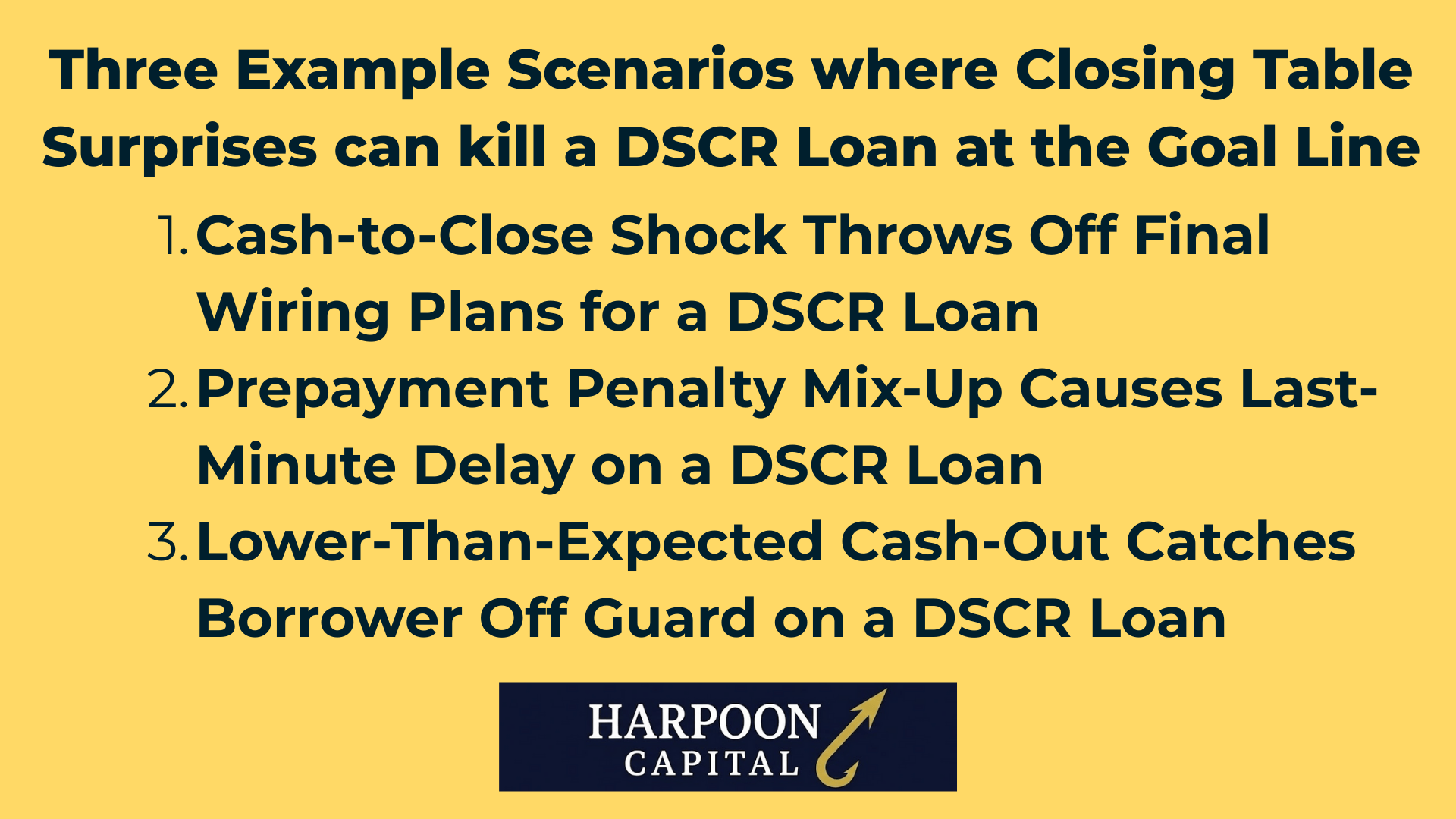
While there are many sorts of things that can qualify as “surprises” at the closing table that can threaten to derail a deal and cause the borrower to get cold feet or be so upset as to walk away in a fit of red, hot anger. Here are three unfortunately common such issues that can arise with DSCR lending:
An investor budgets $60,000 for the down payment and closing costs on a DSCR Loan purchase, based on the initial term sheet received at the start of the process. The quote listed “two months tax escrow” as standard, along with familiar items like appraisal and underwriting fees. Everything appears on track until the final settlement statement arrives the night before closing with much more than $80,000 due, a far greater amount than was planned for. When the borrower asks why the tax escrow suddenly ballooned to six months, the lender explains that while “two months is standard,” they collected additional escrow because a large property tax installment was coming due soon after closing.
The surprises don’t stop there. Alongside the expected underwriting fee, the borrower spots a list of new, unfamiliar charges, several that look suspiciously like junk fees. The most glaring is a “Document Preparation Fee” of $1,900, which online research shows is typically $100 to $250 at most. Other miscellaneous administrative and “funding” charges also appear. These were in the “fine print” of the term sheet, but no specific dollar amounts were specified, making it a “grey area” of whether they were truly disclosed or not. With wiring deadlines approaching, the borrower scrambles to verify the legitimacy of the fees and source extra funds to cover the higher amount due. The deal eventually closes, but the experience leaves a sour taste.
An experienced investor is refinancing a DSCR Loan on a small multifamily property to pull out equity and lock in a better long-term rate. The term sheet he signed months earlier clearly stated “5-Year Prepayment Penalty,” which he assumed referred to a standard step-down structure, i.e. 5–4–3–2–1, where the penalty percentage decreases each year. Confident it matched what he’d seen on other DSCR Loans, he didn’t press for clarification. Fast forward to closing: when the final note and rider arrive, he’s stunned to find the prepayment provision doesn’t step down at all. Instead, it’s written as a flat 5% penalty for the full five years, meaning he’d owe 5% of the outstanding balance no matter when he pays off the loan before year six.
The difference is massive. The investor had planned to potentially sell or refinance within two to three years, expecting a manageable early-exit cost. Under the flat 5% clause, that plan would now cost tens of thousands more. He halts the signing immediately, calling his loan officer and the DSCR Lender’s closing department for clarification. The DSCR Lender points out that the flat 5% structure was indeed disclosed, just not in language that made the difference obvious. If the investor wants to change the provision from flat 5% to step-down, the DSCR Lender informs him that the interest rate will need to be 0.25% higher and the loan documents will need to be re-drafted, costing him a $500 redrafting fee and two more days of timeline.
An investor applies for a DSCR Loan cash-out refinance expecting to net $100,000 in proceeds, planning to use the funds as down payment on a new property. Based on the lender’s preliminary valuation estimates, the numbers appeared solid: 75.0% LTV, a 1.10x DSCR ratio and projected monthly cash flow that easily met guidelines. But when the appraisal comes in lower than expected, and property insurance premiums come in higher, the underwriter must reduce the loan amount to maintain both the maximum LTV and the minimum DSCR ratio requirements. The DSCR Loan still qualifies, and the terms are still based on the same pricing “buckets,” but the loan amount is now reduced to fit. The adjustment drops the net cash-out to $72,000, a $28,000 shortfall.
The borrower doesn’t realize the change until the final closing documents are presented for review. With funds already committed to the next investment, the smaller payout throws the entire strategy into question. Frustration mounts as the investor and lender representative review the math, discovering the new appraisal value and DSCR ratio. The DSCR Loan still closes, but the investor leaves the table disappointed and financially constrained.
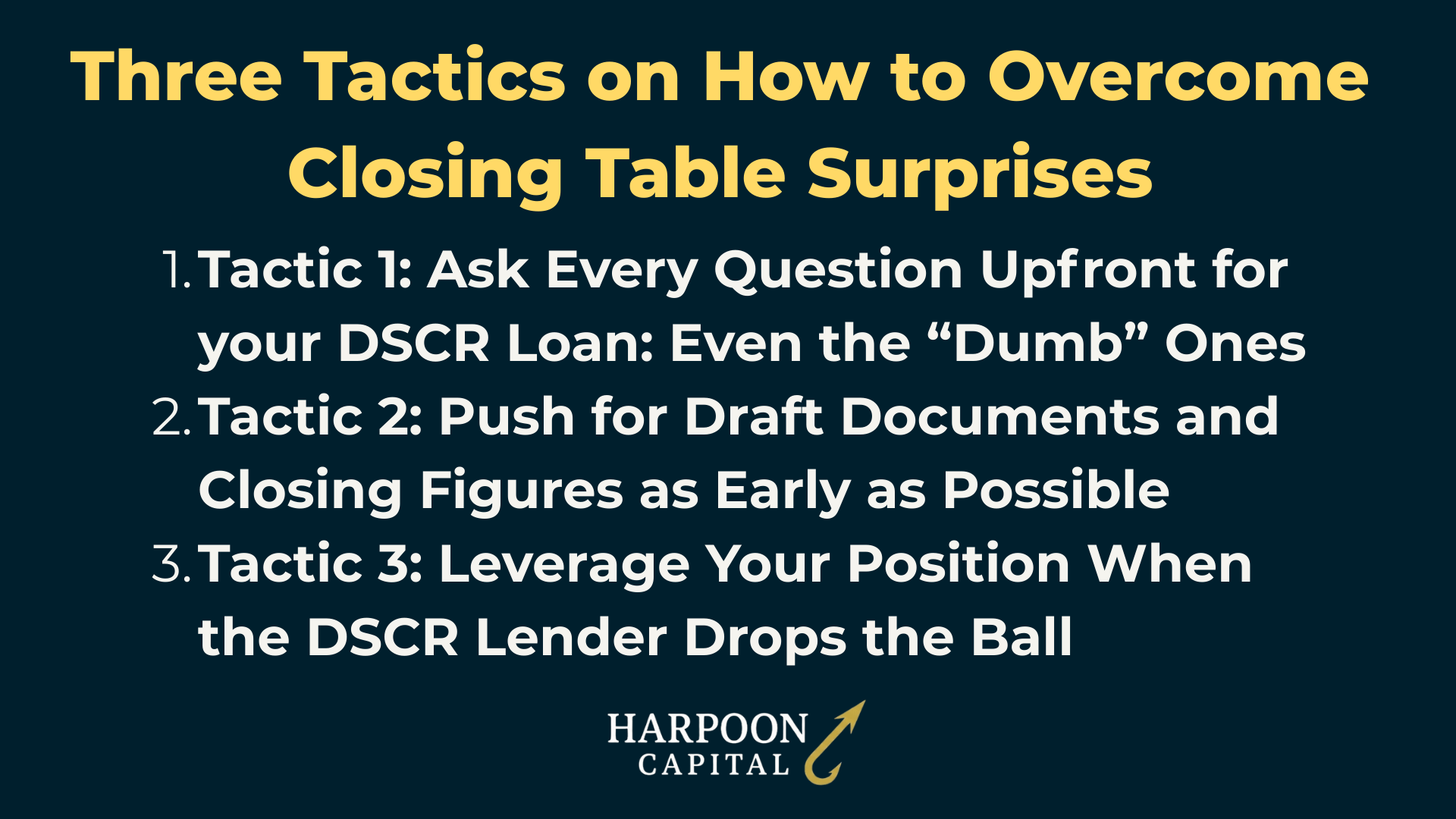
While the specific surprises that could create issues at the closing table can vary widely, the way to avoid them does not vary: it really comes down to preparation through education on DSCR Loans and not being afraid to ask questions about anything. There is no shame in asking questions; it’s part of being prepared. While it is not advisable to deliberately “misunderstand” or claim to misunderstand something before hitting the closing table, also realizing the DSCR Lender’s perspective, i.e. they stand to lose out on significant dollars if a deal dies at the end, can be helpful, particularly if the miscommunication and effects of that misunderstanding can fairly be placed on their shoulders.

For DSCR Loans, assumptions are dangerous and acronyms can be deceiving. Always take the time to confirm every term, condition, and fee on your term sheet or quote, even if something seems self-explanatory or sounds familiar from a previous deal. Ask your mortgage broker or lender account representative to spell out the exact structure of prepayment penalties, interest-only periods, escrow requirements and any lender or underwriting fees that appear vague or lumped together under catch-all labels like “processing” or “doc prep.” Don’t worry about “looking inexperienced” by asking questions; a few extra minutes of clarification can prevent days of stress or thousands in unexpected costs later. If you’re not sure what a term means, ask for a plain-English explanation or a written breakdown and always try to get everything “in writing” (e-mail counts). The borrowers who come to the closing table confident and calm are the ones who were unafraid to look curious at the start.
One of the simplest ways to prevent closing-table chaos is to see everything early. While DSCR Lenders aren’t required to issue a “Closing Disclosure (CD)” like conventional lenders, many will prepare one or a draft settlement statement upon request. Ask for it as soon as your DSCR Loan moves into final underwriting so you can compare the numbers, cash-to-close, estimated proceeds, and all itemized fees, against your quote and term sheet. Do the same for loan documents: review the note, deed of trust, and prepayment rider in draft form if possible. Even catching a small error like the wrong vesting name or an outdated entity address early can save days of delay later. The further in advance you review, the more time the DSCR Lender has to correct or address any discrepancies without redrawing documents under pressure.
If a major miscommunication or missing disclosure can clearly be traced back to the lender or broker, say, an undisclosed underwriting fee, inflated “doc prep” charge or junk fee that was never mentioned on the quote, you have negotiating power. Don’t be afraid to push back. Calmly but firmly point out the discrepancy, reference your original term sheet, and state that you’re unwilling to close unless the fee is corrected. Most DSCR Lenders stand to lose substantial revenue if a deal dies at the finish line, so they’ll often concede to keep the closing intact. You can also request an adjustment or credit on the final statement if a mistake caused a rate-lock extension or other delay. Standing your ground respectfully but assertively signals that you know your numbers, and that you expect the same level of professionalism from your lending partners as you bring to the deal.
Up Next: Common Obstacle #10: Overcome Post-Close Servicing Scares for DSCR Loans
© 2026 Harpoon Capital LLC. All Rights Reserved. WARNING: Unauthorized distribution, copying, or sharing of this guide is a violation of U.S. Federal Law and is punishable by civil penalties of up to $150,000 per violation. We aggressively enforce our intellectual property rights.