.png)

Signing looks simple on the surface: show up, sign papers, get funded. But for DSCR Loans, where loans often involve LLCs, multiple guarantors and state-specific quirks, the signing table can become a major obstacle. The most common pitfalls are requirements borrowers didn’t anticipate: spousal signatures, entity resolutions, travel or scheduling conflicts, or restrictions on Power of Attorney (POA). What feels like a small formality can end up delaying funding by days or weeks, or even having this delay kill the deal entirely!

Signing issues are a surprisingly common occurrence with DSCR Loans, likely driven by the fact that they are commonly made to investors that are used to the more personal and simplified signings of conventional residential real estate loans (i.e. the individual simply signs the documents) and are unfamiliar with the nuances of business-purpose lending with LLCs and other issues. Typically, these signing issues come from three areas, spousal consent surprises, especially in “community property states,” attorney-involvements in states with mandatory lawyer involvement rules and complex signature authorizations with LLCs and other entity structures.
An investor closing on a DSCR Loan purchase under an LLC in Texas is blindsided when the title company informs him that his non-borrowing spouse must sign the Deed of Trust to waive community property rights. His wife, who isn’t involved in the LLC or the transaction, refuses at first, frustrated that she’s being asked to sign for “his business deal.” The DSCR Lender can’t fund without the spousal consent, and the closing is postponed while attorneys explain the legal requirement and arrange for her to sign separately. The one-week delay pushes the closing beyond the seller’s contractual deadline, and the seller threatens to walk.
An out-of-state investor schedules a remote signing for a DSCR Loan rate-term refinance on a Brooklyn triplex, expecting a simple mobile-notary mail-away closing. Two days before the scheduled funding, the title company notifies her that New York law requires an attorney to conduct or supervise all real estate closings. Since she doesn’t have local counsel lined up, the loan file stalls while she scrambles to retain a New York attorney and coordinate new signing logistics. The attorney’s fees add $1,200 in unplanned costs, and the new schedule pushes the closing five days past the original rate-lock window. Because of the delay, the DSCR Lender must redraw documents and re-verify payoff figures, turning what should have been a routine refinance into a logistical and financial headache.
A three-member LLC applies for a DSCR Loan refinance on a small multifamily property, with one member taking the lead on the transaction. Everyone assumes that member has signing authority for the group, but when title reviews the operating agreement, it doesn’t specify who can bind the entity. The DSCR Lender’s attorney flags the issue immediately and halts funding until a formal corporate resolution is executed by all members. One member is on an overseas business trip, another is traveling out of state and coordinating signatures across time zones proves slow and costly. The delay forces the title company to reschedule the notary, reissue documents, and push the closing into the following month, adding rush fees and another round of payoff recalculations.
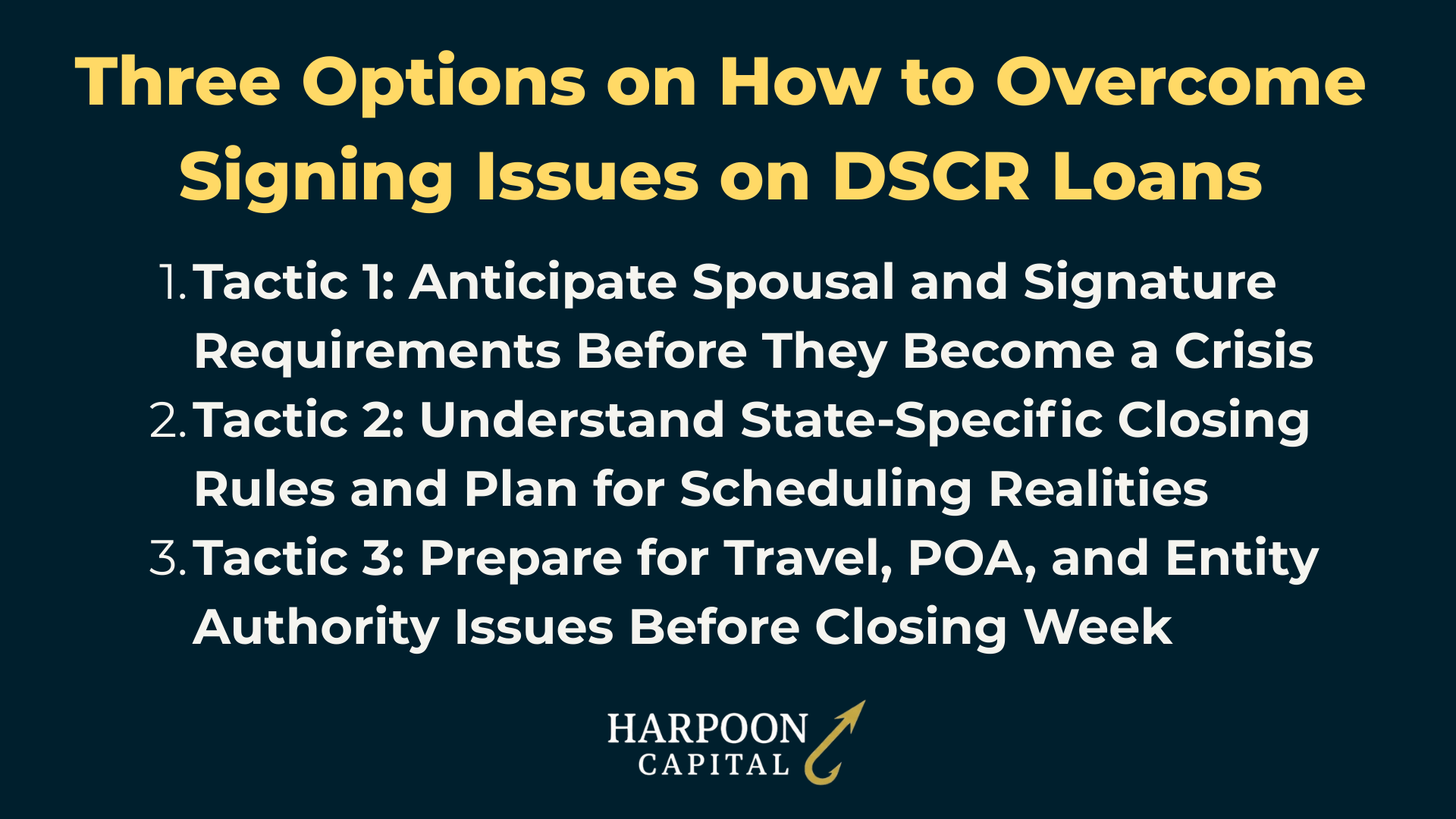
The good news for overcoming any potential signing obstacles for DSCR Loans is that they are pretty much all avoidable with knowledge and preparation. The rules around spousal consent (and which states are “community property states” that require it), attorney closing involvement and LLC signing authorities are all knowable in advance and can be confirmed through your lender or title representative or even your own research. You can overcome these obstacles simply by preparing well, so a signing snafu can be avoided on your DSCR Loan.

When properties or borrowers are based in community property states, assume from the start that a spouse or additional signer may need to be involved, even if they’re not on title or in the LLC. Spousal consent signatures are one of the most common last-minute curveballs facing DSCR Loans, particularly since community property rules apply to high-volume states including Texas, Arizona and California. The surprise comes not from complexity, but from lack of preparation. The best approach is to confirm marital status and title vesting details with your DSCR Lender and title company early in the process so required signatures can be added to the initial closing package. Similarly, if an entity has multiple members or guarantors, ensure everyone who might be asked to sign knows their role and is available. Few things derail funding faster than someone who’s traveling, unaware they’re needed at the table or reluctant to sign because they weren’t looped in until the last minute.

Each state handles real estate closings differently, and DSCR Loan borrowers, especially out-of-state investors, are often caught off guard by those differences. Some states, such as New York, Georgia, and South Carolina, require an attorney to conduct or oversee the closing. Others allow mobile notaries or e-notarization, but only if certificates meet strict formatting or witnessing standards. Knowing which applies to your property early on lets you plan for attorney fees, availability and the additional coordination that comes with mail-away closings or remote signings. Even within the same state, local customs vary by county, so confirm who’s authorized to notarize and what the lender will accept before final loan documents are issued. The more you understand the logistics ahead of time, the less likely you’ll face last-minute surprises, redraws, or costly rate-lock extensions when the signing table turns out to be more complicated than expected.
Because DSCR Loan borrowers are often active investors or business owners with busy schedules, travel conflicts and entity-authorization gaps are common. Believe it or not, borrowers being overseas and traveling in far flung destinations around the closing date is extremely common. When you think about it, since DSCR Loans are often the engine of creating financial freedom through real estate investing, maybe it shouldn’t be a surprise that DSCR Loan borrowers are often enjoying such freedom, and on vacation!
If you or any guarantor will be out of state, or worse, out of the country, during the anticipated closing window (or typically, a week or two after the initially planned closing, i.e. with common delays, this becomes the “actual” closing window), tell your DSCR Lender and title company early. Some lenders allow e-notary closings or domestic remote signings, but international signings typically require notarization at a U.S. Embassy or Consulate, where appointments can take weeks to secure. Power of Attorney (POA) options are rarely accepted and must be reviewed and recorded well in advance if they are. Likewise, for LLCs or corporations, make sure your operating agreement clearly defines who has authority to borrow and sign. If not, execute a written resolution signed by all members before closing week begins. These small steps keep a deal from falling apart simply because the right person wasn’t in the right place, or couldn’t legally sign, when the money was ready to move.
Next: Common Obstacle #7: How To Overcome Large Deposit Sourcing Issues for DSCR Loans
© 2026 Harpoon Capital LLC. All Rights Reserved. WARNING: Unauthorized distribution, copying, or sharing of this guide is a violation of U.S. Federal Law and is punishable by civil penalties of up to $150,000 per violation. We aggressively enforce our intellectual property rights.