.png)


While this last common obstacle isn’t exactly a fit for throwing off a DSCR Loan, it’s important for every well-prepared DSCR Loan borrower. Servicing issues unfortunately plague the world of DSCR Loans, and while they can’t actually “undo” a DSCR Loan that has successfully closed and funded, they can and do jeopardize the success of future DSCR Loans, either for additional properties or a refinance on the same property being serviced down the line. As such, it’s highly important that DSCR Loan borrowers are on the lookout for these servicing issue obstacles that can cause a lot of damage to current and future real estate investing endeavors.

There are several issues that cause havoc with servicing, and most occur in the short period between the closing of the loan and the first few monthly payments, which typically involve the DSCR Loan being sold and transferred to a new servicer. It is usually smooth sailing once this first transfer has occurred, but the first few months can be stormy seas, so being ultra vigilant right after you might think it’s over – i.e. the closing and funding of the loan, is critical.
An investor is required by his DSCR Lender to sign a consent to automatic ACH payments when signing the final loan documents package, entering bank details directly onto the form when signing at the title company office. A single digit in the routing number is slightly illegible, and the servicing associate types in a “6” rather than a “5” when inputting it into the system. A month and a half later, when the first PITIA payment is processed, it bounces back as a “non-sufficient funds” (NSF) error. The borrower’s account has plenty of money, but the system flags the payment as failed. When the DSCR Lender’s servicer attempts to reach out to the borrower multiple times, he ignores the calls since he is inundated with spam calls daily, and the servicer never leaves a voicemail or text to follow up.
By the time the error is caught and corrected, the loan servicer has already assessed a $50 NSF fee and reported the payment as late to the credit bureau. When the investor later applies for another DSCR Loan refinance a few months later, the “30-day late” mark triggers higher pricing and a letter of explanation. While blame could arguably be laid on both sides, borrower and lender’s servicer, the damage is done, and it will be over 12 months before this “real estate late” payment rolls off the credit report.
Three months after closing, an investor receives a short letter in the mail notifying him that his DSCR Loan servicing has been transferred to a new company. The letter looks routine, just a standard “goodbye letter” notice, and he assumes there’s nothing to do. After all, at closing, he had been required to sign an ACH authorization form allowing the lender to automatically debit his payments each month, as well as a separate servicing disclosure stating that if the loan was ever sold or transferred, the new servicer would automatically receive the same authorization and account information. In other words, he had already granted full consent for the new company to continue drafting his payments, so as long as he continued to have enough money in the bank account, nothing needed to change.
Unfortunately, that assumption turns out to be costly. The original DSCR Lender properly transfers servicing, but the new servicer’s automated system fails to import his ACH data correctly. When the first payment under the new servicer comes due, the draft never processes. Two weeks later, the borrower receives a delinquency notice and a $75 late fee, despite having the funds sitting in his account. Confused, he calls his original lender representative, who refers him to the new servicer, who insists that his ACH setup was never completed on their end. To correct it, he must reauthorize the ACH form directly with them and manually submit the missed payment to bring the account current.
By the time the issue is resolved, a late notice has already been issued and reported internally as a “technical delinquency.” Though he manages to have the fee waived, the borrower spends hours untangling what should have been an automated, frictionless process. Worse, when he later applies for another refinance, the new DSCR Lender flags the account history for a “recent late payment,” forcing additional documentation and explanation. The borrower did everything right, signed the ACH forms, read the servicing disclosures, and had sufficient funds, but the handoff between systems wasn’t flawless, and he paid the price for assuming it would be.
An investor with several DSCR Loan-financed rentals sets all loans on automatic ACH drafts due on the first of the month, assuming the system will take care of itself. But one month later, two tenants pay rent several days late, on the 5th and the 8th, while the PITIA drafts hit the account right on schedule. The funds aren’t there in time, triggering NSF (non-sufficient funds) notices, $75 return fees per loan, and a cascade of “payment failed” alerts from the servicer. The investor immediately transfers money to cover the payments, but the system’s delayed reattempt pushes both payments beyond the grace window, generating late notices and internal delinquency records.
Though no 30-day lates appear on credit, the incident lingers in the loan’s servicing history. When the investor later applies for another DSCR Loan refinance, the underwriter flags the NSF events as a liquidity management issue and requests months of additional bank statements and explanations. What started as a harmless timing mismatch between rent receipts and auto-drafts ends up adding costs, delays and unnecessary scrutiny to the investor’s next deal.
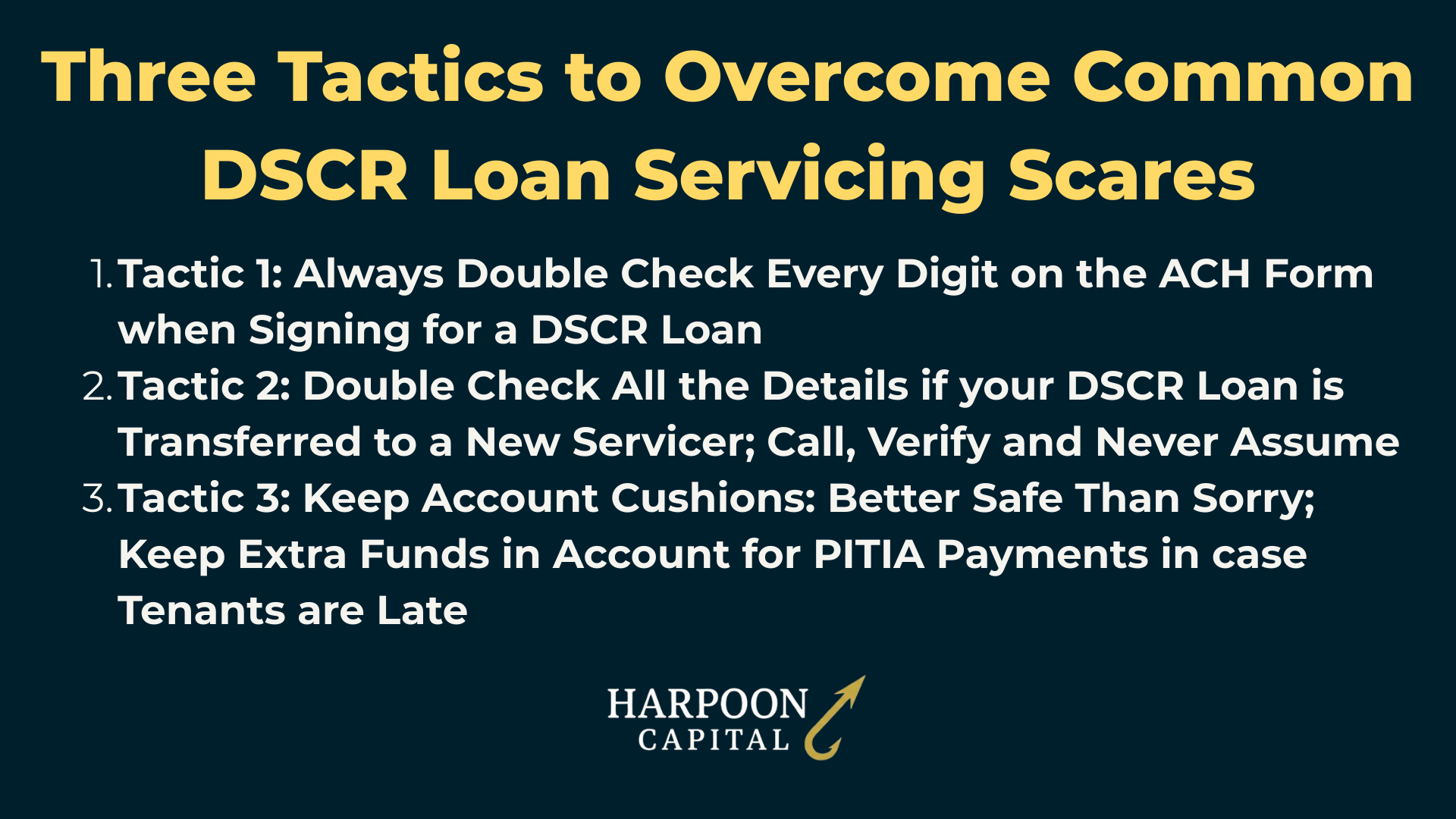
Servicing issues are some of the worst “obstacles” to a good experience with DSCR Loans, particularly because of all the potential problems, these are the ones most likely to not be the borrower’s fault, and rather the fault of poorly performing payment processing companies – “servicers.” However, as everyone knows, and especially real estate investors, “life isn’t fair,” and while it’s not ideal for borrowers to have to spend extra time to prevent and fix any problems that aren’t their fault, it’s definitely worth it. Here are three tactics that shouldn’t be necessary, but unfortunately often are.
Automatic payments are convenient and often required for DSCR Loans, but they also introduce risk if even a single character is wrong. Before signing your closing package, take the time to carefully review every digit on your ACH authorization form, the routing number, account number, payment start date and the account name exactly as it appears at your bank. A single typo or mismatched account title can cause an automatic payment to fail, leading to NSF notices, late fees and even false delinquency reports that can follow you into future loans. Don’t assume the escrow agent or lender entered the information correctly just because they handle it every day. These forms are filled out fast during signing, and a misplaced digit can cause major headaches down the line.
Once your first payment is scheduled, confirm it posts properly. Log into your servicer’s portal a few days after the due date to verify that the ACH draft cleared for the right amount and that your account reflects “paid as agreed.” If you see anything off, wrong date, duplicate draft, or a missing payment, contact the servicer immediately and request written confirmation once corrected. DSCR Lenders care about payment history, and even one erroneous late mark can make your next refinance harder or more expensive. A five-minute double-check at closing and on your first payment is one of the easiest ways to protect your investment record.
Servicing transfers are common for DSCR Loans, since most loans are sold to aggregators or securitizers, companies that are separate from those that actually provide the loans. Even if you signed disclosures allowing a new servicer to take over your ACH authorization, it’s risky to assume the handoff will be seamless. When you receive a transfer notice, read it carefully and call both the old and new servicers to confirm key details: your next payment due date, where it will draft from and whether your ACH setup transferred correctly. Many investors have learned the hard way that data doesn’t always migrate perfectly between systems, and one missed draft can trigger late fees or payment errors that take months to clear up.
Don’t just rely on automated emails or mailed notices. Ask for written confirmation that your ACH authorization is active with the new servicer, and monitor your bank account to verify the first payment clears successfully after the transfer. Keep all correspondence and receipts in your loan file, especially if the loan is new or has recently changed hands. Servicing errors aren’t rare, and they’re not always caught quickly. A short phone call and a few screenshots can save you from costly mistakes, unnecessary late marks, and hours of cleanup later.
Many real estate investors rely on rental income to cover the payments for their DSCR Loans, but tenants don’t always pay on the first of the month. Having a cash buffer, at least one full month’s PITIA payment, sitting in your draft account ensures your automatic mortgage payments clear even if rent hits a few days late or an unexpected repair bill drains funds temporarily. Too many borrowers run their loan accounts razor-thin, assuming rent and ACH timing will always line up. When that assumption fails, NSF notices and reattempt fees follow. A small cushion can prevent those fees, protect your payment history, and avoid a needless red flag on your next DSCR Loan application.
Consider maintaining a dedicated “loan servicing account” just for DSCR Loan payments, funded once per month from your operating account. Keeping this account clean and predictable prevents rent and expense fluctuations from interfering with automated drafts. In short, think of your DSCR Loan payments like payroll, nonnegotiable and always covered first. A small liquidity cushion isn’t just good practice; it’s one of the simplest risk-management habits that separates smooth-scaling investors from those constantly fighting fires at the end of every month.
© 2026 Harpoon Capital LLC. All Rights Reserved. WARNING: Unauthorized distribution, copying, or sharing of this guide is a violation of U.S. Federal Law and is punishable by civil penalties of up to $150,000 per violation. We aggressively enforce our intellectual property rights.